fēond
/ˈfeː.ond/ · Old English strong masculine nd-agent noun
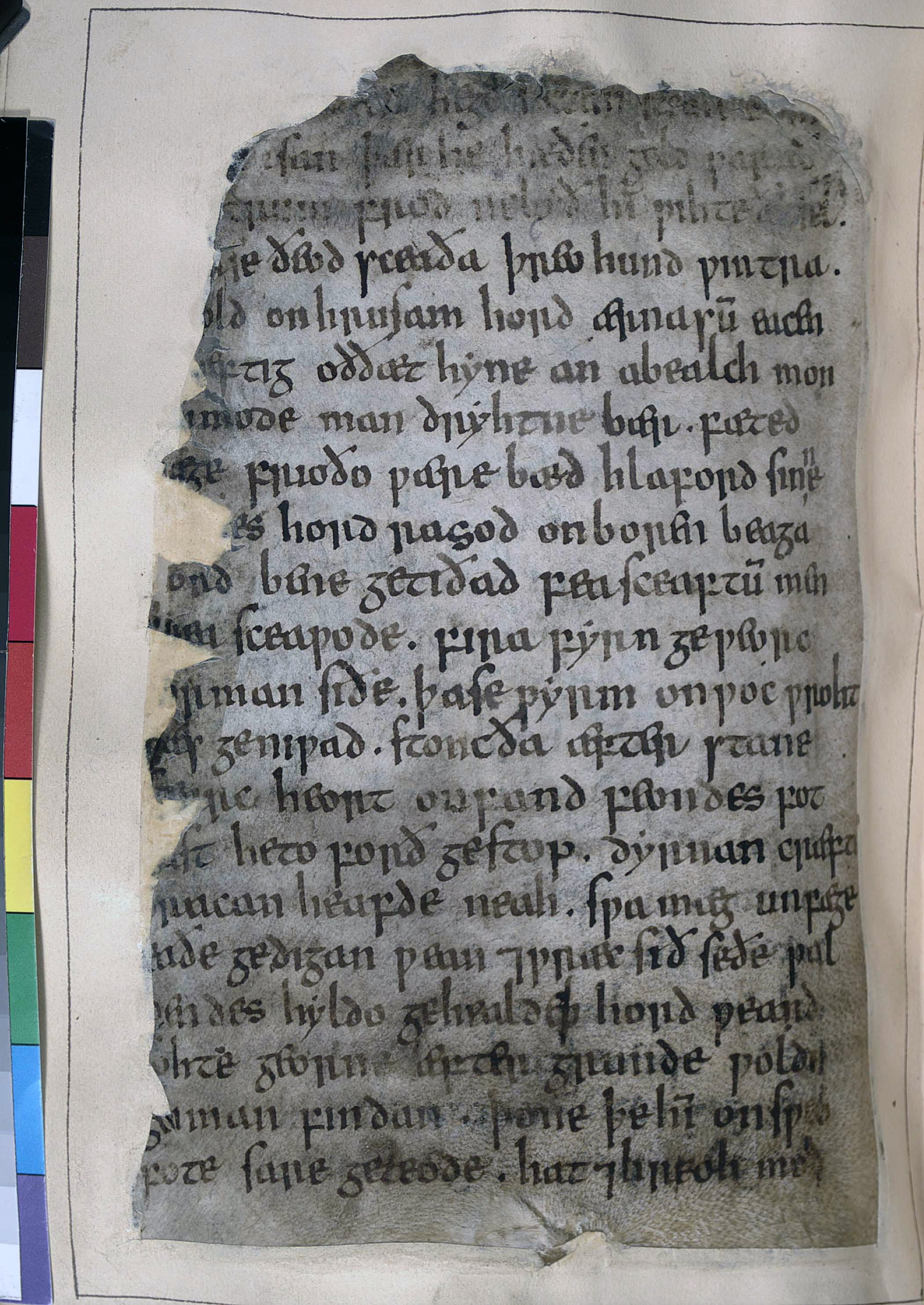
An Old English enemy, foe, and Devil noun inherited from the Germanic lexicalized present-participial formation *fi(j)and-. OED’s revised 2026 entry treats fēond and fīond as dialectal Old English forms, documents i-mutated fīend and fȳnd inside the inherited nd-stem inflection, and traces the word through a highly variable Middle English record into modern fiend. Bosworth–Toller supplies the Old English paradigm and examples; the Middle English Dictionary independently reports 188 quotations across eight senses. Cotton MS Vitellius A XV folio 180v was directly inspected at Beowulf 2289, where feondes modifies fotlast, the foe’s footprint.
Lineage, to the limit of knowledge
5 steps from today back to *peh₁- (Proto-Indo-European). An asterisk marks a form reconstructed by comparison, never found written.
- Sound
- Old English fēond continues the Germanic nd-agent formation with West Germanic vowel and inflectional development.
- Meaning
- The lexicalized one-who-hates formation remains an enemy or foe noun and also supplies a devil sense in Old English.
- Authority
- Daniel Ayora Estevan · Bosworth–Toller editors
- Confidence
- Cross-Germanic comparison and the Old English entry support inheritance; exact intermediate phonetic detail remains reconstructed.
- Chronology
- Proto-Germanic reconstruction into the Old English written record.
- supports On the syntax of the Agent nouns in Gothic: the case of nd-formations (Daniel Ayora Estevan, 2023), p. 47 note 24, Old English fēond among inherited Germanic enemy nounsPlaces Old English on the pre-Gothic lexicalized-agent branch.
- supports An Anglo-Saxon Dictionary Online — feónd (Joseph Bosworth · Thomas Northcote Toller · Christ Sean · Ondřej Tichy, 2014), Grammar and etymology from feónd through Germanic comparandaSupplies the Old English paradigm, hate-verb derivation, senses, and comparative forms.
- supports Oxford English Dictionary — fiend, n., revised 2026 (Oxford English Dictionary Editors, 2026), Etymology summary and Old English notesPublishes inherited Germanic ancestry, Old English dialect forms, the nd-agent inflection, and the participial source.
- Sound
- The present-participial nd-formation is built on the fi(j)- verb stem.
- Meaning
- One who hates lexicalizes as enemy before Gothic, while productive participial use survives beside the noun.
- Authority
- Daniel Ayora Estevan · Guus Kroonen
- Confidence
- The derivation and pre-Gothic lexicalization are published; the exact moment and every token’s category remain unrecoverable.
- Chronology
- Proto-Germanic derivation and lexicalization before the Gothic branch record.
- supports Etymological Dictionary of Proto-Germanic — *fi(j)ēn- and *fi(j)and- (Guus Kroonen, 2013), p. 140, *fi(j)and- from *fi(j)ēn-Publishes the reconstructed Germanic word-formation relationship.
- supports On the syntax of the Agent nouns in Gothic: the case of nd-formations (Daniel Ayora Estevan, 2023), pp. 47–49, lexicalized enemy noun beside productive present participlesPublishes the pre-branch lexicalization and living participial system.
- supports Oxford English Dictionary — fiend, n., revised 2026 (Oxford English Dictionary Editors, 2026), Etymology summary: noun use of the present participle of the hate verbIndependently identifies the agent-noun formation and compares the parallel antonym friend.
- Sound
- The proposed analysis connects the Germanic fi(j)- verb to a laryngeal-bearing Indo-European base through prehistoric present-stem remodeling; intermediate formal analyses vary and are not presented as written stages.
- Meaning
- A proposed harm, blame, suffering, or hostility field develops toward the Germanic verb hate, but the original semantic center is not uniquely recoverable.
- Authority
- Guus Kroonen
- Confidence
- The Proto-Germanic comparison is firmer than the displayed PIE route. The exact intermediate reconstruction and semantic unity remain analytical proposals.
- Chronology
- Proposed Proto-Indo-European base to Proto-Germanic reconstruction.
- supports Etymological Dictionary of Proto-Germanic — *fi(j)ēn- and *fi(j)and- (Guus Kroonen, 2013), p. 140, deeper etymological analysis of *fi(j)ēn-Publishes the proposed Indo-European route used here with reduced confidence.
- Sound
- No older form is promoted beyond the proposed *peh₁- comparison.
- Meaning
- The trail ends before the Old English enemy, Devil, or demon history is reverse-engineered into one universal prehistoric concept.
- Authority
- SET-U editorial boundary · Guus Kroonen
- Confidence
- The deeper base is already proposed; no earlier node is treated as secure.
- supports Etymological Dictionary of Proto-Germanic — *fi(j)ēn- and *fi(j)and- (Guus Kroonen, 2013), p. 140, deepest published comparison used in this dossierSupports stopping after the qualified PIE proposal rather than inventing an earlier node.
Relatives
| Form | Language | Relation | Source |
|---|---|---|---|
| fiend | English | the direct modern continuation; its original enemy sense is obsolete while Devil, demon, and cruel-person senses survive | Oxford English Dictionary — fiend, n., revised 2026 |
| fẹ̄nd | Middle English | the Middle English headword with 188 dictionary quotations across eight senses | Middle English Dictionary — fẹ̄nd, n. |
| friend | English | the antonym identified by OED as a similar Germanic agent-noun formation, not a descendant of fēond | Oxford English Dictionary — fiend, n., revised 2026 |
| fīond | Old English | a chiefly Northumbrian and Kentish dialect form of the same noun | Oxford English Dictionary — fiend, n., revised 2026 |
| fīend | Old English | an inherited i-mutated inflectional form, not a separate modern word | Oxford English Dictionary — fiend, n., revised 2026 |
| fȳnd | Old English | a late West Saxon i-mutated form and plural | Oxford English Dictionary — fiend, n., revised 2026 |
| fēondas | Old English | a re-formed strong-masculine plural found especially in Anglian and verse sources | Oxford English Dictionary — fiend, n., revised 2026 |
| gefīend | Old English | a prefixed plural with the mutated stem | Oxford English Dictionary — fiend, n., revised 2026 |
| eald-feónd | Old English | an Old English compound or phrase naming the Old Enemy | An Anglo-Saxon Dictionary Online — feónd |
| þeód-feónd | Old English | a derived Old English enemy compound listed by Bosworth–Toller | An Anglo-Saxon Dictionary Online — feónd |
| feónd-ǽt | Old English | a compound entry in the Bosworth–Toller word wheel | An Anglo-Saxon Dictionary Online — feónd |
| feónd-gráp | Old English | a compound entry built on the enemy noun | An Anglo-Saxon Dictionary Online — feónd |
| feóndlīc | Old English | an adjective derived from the enemy noun | An Anglo-Saxon Dictionary Online — feónd |
| fiānd | Old Frisian | a West Germanic cognate from the inherited participial enemy formation | Oxford English Dictionary — fiend, n., revised 2026 |
| fīunt | Old Dutch | a West Germanic cognate continued by Dutch vijand | Oxford English Dictionary — fiend, n., revised 2026 |
| fīond | Old Saxon | a West Germanic cognate preserving the enemy noun | Oxford English Dictionary — fiend, n., revised 2026 |
| fīant | Old High German | a High German cognate continued by German Feind | Oxford English Dictionary — fiend, n., revised 2026 |
| Feind | German | the modern German continuation of the inherited enemy noun | Oxford English Dictionary — fiend, n., revised 2026 |
| fjándi | Old Icelandic | a North Germanic cognate from the same participial formation | Oxford English Dictionary — fiend, n., revised 2026 |
| fiende | Old Swedish | a North Germanic cognate in the comparative set | Oxford English Dictionary — fiend, n., revised 2026 |
| fjende | Danish | the modern Danish continuation listed in OED’s cognate set | Oxford English Dictionary — fiend, n., revised 2026 |
| fijands | Gothic | the reviewed Gothic cousin from the same lexicalized Proto-Germanic formation | On the syntax of the Agent nouns in Gothic: the case of nd-formations |
| fēogan | Old English | the Old English hate verb whose present-participial base underlies the agent noun | Oxford English Dictionary — fiend, n., revised 2026 |
Journey
- Proto-Indo-European linguistic horizon · proposed *peh₁- comparisonA deeper harm, blame, suffering, or hate comparison is published, but its exact formation and semantic unity remain proposed.
- Proto-Germanic linguistic horizon · *fi(j)ēn- and lexicalized *fi(j)and-Germanic branches preserve both the hate verb and lexicalized present-participial enemy noun. The asterisked forms are comparative reconstructions.
- Old English-speaking England · fēond, fīond, fīend, and fȳndDialect and inflection create multiple Old English vowels and plural patterns without creating separate enemy lexemes.
- England, copying place unresolved · Cotton MS Vitellius A XV, folio 180vThe directly inspected Beowulf folio visibly preserves feondes fotlast. The reviewed sources identify the unique manuscript but do not reduce its copying place to one secure coordinate.
- Middle English written record · fẹ̄nd and extensive spelling variationThe Middle English Dictionary records 188 quotations across enemy, Devil, demon, possession, monster, and related senses, while OED documents inherited and remodeled plurals.
- Early Modern English record · fend, feend, feinde, and fiendOED records competing long and short vowel pronunciations and extensive spelling variation before the long vowel becomes dominant by the eighteenth century.
- Global English · modern fiendThe literal enemy or foe sense is obsolete, while Devil, demon, wicked-person, harmful-thing, and later figurative uses continue in English.
- Knowledge boundary · beyond the proposed Indo-European comparisonNo single hater, enemy, Devil, adversary, harm, blame, suffering, or hostility origin is promoted beyond the qualified route.
Disputes
Did Old English fēond mean only the Devil?
No. Bosworth–Toller gives enemy, foe, and Devil, while OED separates literal enemy, the Devil, demons, and malevolent-person uses already present in Old English.
resolved · confidence: established · The dossier keeps the senses distinct instead of retrojecting modern fiend onto every token.
- supports An Anglo-Saxon Dictionary Online — feónd (Joseph Bosworth · Thomas Northcote Toller · Christ Sean · Ondřej Tichy, 2014), Definition and examples: enemy, foe, the DevilDocuments the Old English sense range.
- supports Oxford English Dictionary — fiend, n., revised 2026 (Oxford English Dictionary Editors, 2026), Meaning and use, senses 1–4Separates literal enemy, Satan, fallen spirits, and cruel-person uses.
Is English fiend descended from Gothic fijands?
No. English fiend continues Old English fēond; Gothic fijands is a collateral Germanic cousin. Both meet at the reconstructed *fi(j)and- formation.
resolved · confidence: established · No Gothic-to-English borrowing edge is drawn.
- supports On the syntax of the Agent nouns in Gothic: the case of nd-formations (Daniel Ayora Estevan, 2023), p. 47 note 24, Gothic and Old English as Germanic parallelsPlaces the two words on collateral branches.
- supports Oxford English Dictionary — fiend, n., revised 2026 (Oxford English Dictionary Editors, 2026), Etymology summary and later developmentPublishes the direct inherited English line.
Was fēond still just an ordinary Old English present participle?
No. OED classifies it as a strong masculine agent noun originally in the nd-class, and cross-Germanic evidence places lexicalization before Old English. Its participial origin remains historically visible without erasing noun status.
resolved · confidence: probable · The graph uses lexicalized_participle for historical formation and noun for the attested Old English category.
- supports On the syntax of the Agent nouns in Gothic: the case of nd-formations (Daniel Ayora Estevan, 2023), p. 47, pre-Gothic lexicalizationPlaces noun lexicalization before the recorded branch.
- supports Oxford English Dictionary — fiend, n., revised 2026 (Oxford English Dictionary Editors, 2026), Old English notes: strong masculine nd-agent nounPublishes the attested noun class and participial origin.
Do fēond, fīond, fīend, and fȳnd name separate words?
No. OED explains unmutated dialect forms and i-mutated inflectional forms inside one inherited paradigm, with later analogical remodeling.
resolved · confidence: established · The variants remain relatives and witnesses of one dossier rather than duplicate headwords.
- supports Oxford English Dictionary — fiend, n., revised 2026 (Oxford English Dictionary Editors, 2026), Old English notes and variant formsExplains dialectal, mutated, endingless, and remodeled forms.
- context An Anglo-Saxon Dictionary Online — feónd (Joseph Bosworth · Thomas Northcote Toller · Christ Sean · Ondřej Tichy, 2014), Grammar: feónd, fiónd, fýnd, fiénd and inflectionIndependently records the paradigm.
Did fiend originally mean demon?
No. OED dates enemy or foe from Old English to 1450 and marks it obsolete; Devil was originally a specific use of enemy as the ultimate adversary.
resolved · confidence: established · The semantic route preserves specialization rather than replacing the early range with the modern one.
- supports Oxford English Dictionary — fiend, n., revised 2026 (Oxford English Dictionary Editors, 2026), Sense 1, enemy or foe, obsolete; sense 2, the DevilPublishes the semantic ordering and survival difference.
- context Middle English Dictionary — fẹ̄nd, n. (Middle English Dictionary Editors, 2026), Eight Middle English senses and formsShows the enlarged medieval Devil, demon, possession, and monster network.
Why could enemy become the Devil?
OED explains the Devil as the original or ultimate enemy, early translating Latin hostis and ultimately reflecting the literal adversary sense of Hebrew satan. This is a semantic and translation history, not proof of one coinage event.
resolved · confidence: established · The site states the bridge without inventing a unique first metaphor-maker.
- supports Oxford English Dictionary — fiend, n., revised 2026 (Oxford English Dictionary Editors, 2026), Sense 2 note on ultimate enemy, Latin hostis, and Hebrew satanPublishes the adversary-based semantic bridge.
Did Old English fēond have one regular plural?
No. OED records endingless i-mutated and unmutated plurals, re-formed fēondas or fīondas, and occasional weak forms.
resolved · confidence: established · The dossier treats inflectional variation as evidence, not noise.
- supports Oxford English Dictionary — fiend, n., revised 2026 (Oxford English Dictionary Editors, 2026), Old English inflection notesDocuments inherited and remodeled plural systems.
Are fiend and friend the same root with opposite meanings?
No. OED says friend is an antonym with a similar agent-noun formation. Similar morphology does not establish one lexical root or cognate pair.
resolved · confidence: established · Friend is listed as a morphological parallel, not a parent, child, or cognate.
- supports Oxford English Dictionary — fiend, n., revised 2026 (Oxford English Dictionary Editors, 2026), Etymology summary: friend shows a similar formationEstablishes morphological analogy without shared lexical ancestry.
Is the deepest *peh₁- route established?
No. The Germanic verb and lexicalized agent formation are firmer than the proposed Indo-European comparison, whose formal intermediates and semantic unity remain reconstructive.
open · confidence: proposed
- supports Etymological Dictionary of Proto-Germanic — *fi(j)ēn- and *fi(j)and- (Guus Kroonen, 2013), p. 140, deeper analysis of *fi(j)ēn-Publishes the proposed route while leaving it reconstructive.
- context On the syntax of the Agent nouns in Gothic: the case of nd-formations (Daniel Ayora Estevan, 2023), p. 47, firmer lexicalized Germanic formationSupports the shallower relationship more securely.
Does Beowulf 2289 show a demon sense?
No. The directly inspected folio preserves feondes fotlast in a scene where the dragon finds the foe’s footprint. The pixels establish the form and local context, not the entire lexeme.
resolved · confidence: established · The witness record is limited to what the page visibly supports.
- supports Electronic Beowulf, Fifth Edition (Kevin Kiernan, editor and designer · Emil Iacob, software engineer, 2026), Electronic Beowulf line control: verse 2289 to folio 180vSupplies the repeatable edition-to-object alignment.
- supports Cotton MS Vitellius A XV, folio 180v — Electronic Beowulf facsimile (British Library · Kevin Kiernan, editor, 2026), Folio 180v, visible feondes fotlast sequenceProvides the directly inspected manuscript object.
Do 188 Middle English quotations equal the complete history of fiend?
No. They are the Middle English Dictionary’s current quotation set across eight senses, not a count of every historical utterance or surviving token.
resolved · confidence: established · The count is labeled as dictionary evidence rather than language-wide frequency.
- supports Middle English Dictionary — fẹ̄nd, n. (Middle English Dictionary Editors, 2026), Entry summary: 188 quotations in eight sensesDefines the bounded MED evidence set.
Did every early fīend- form arise from inherited i-mutation?
Not necessarily. OED notes that especially in early Mercian, some apparently mutated stems may instead have been re-formed after the present participle of fēon.
open · confidence: probable
- supports Oxford English Dictionary — fiend, n., revised 2026 (Oxford English Dictionary Editors, 2026), Old English note on possible re-formation after the present participlePreserves the alternative explanation for some mutated stems.
Witnesses
- early Old English, source-reported King Alfred’s Pastoral Care, Devil as Old Enemy, Pastoral Care xxxvi. 261
source-reported“of ðæs ealdan feondes honda”lexical_corpus_record · Oxford English Dictionary — fiend, n., revised 2026
- early Old English, source-reported Metres of Boethius, Nero as a wicked person, Metres of Boethius xv. 7
source-reported“Hwæt, se feond swa ðeah his diorlingas duguðum stepte”lexical_corpus_record · Oxford English Dictionary — fiend, n., revised 2026
- Old English, source-reported Boethius, friends and foes contrast, Boethius 20; Fox 72, 21
source-reported“ðine friend and ðine fynd”lexical_corpus_record · An Anglo-Saxon Dictionary Online — feónd
- late 10th or early 11th century Beowulf manuscript, foe’s footprint, Cotton MS Vitellius A XV, fol. 180v, manuscript line 15; Beowulf 2289
directly inspected“stearcheort onfand feondes fotlast”manuscript · British Library · Cotton MS Vitellius A XV, fol. 180v · facsimile · Cotton MS Vitellius A XV, folio 180v — Electronic Beowulf facsimile
- Old English, source-reported Beowulf line 101, enemy in hell, Beowulf 101
source-reported“fyrene fremman, feond on helle”lexical_corpus_record · Oxford English Dictionary — fiend, n., revised 2026
- Old English, source-reported Soul’s enemy example, L. E. I. 3; Thorpe ii 404, 9
source-reported“Seo ydelnes is ðære sawle feond”lexical_corpus_record · An Anglo-Saxon Dictionary Online — feónd
- Old English, source-reported Dream of the Rood, human enemies, Rood 30; Krapp 33
source-reported“Genamon me ðær strange feondas”lexical_corpus_record · An Anglo-Saxon Dictionary Online — feónd
- Old English, source-reported Guthlac A, fallen spirits, Guthlac A 421
source-reported“No þær þa feondas gefeon þorfton”lexical_corpus_record · Oxford English Dictionary — fiend, n., revised 2026
Data for this word: every dataset (JSON, CSV, SQLite).