frēond
approx. /ˈfreːo̯nd/ · Old English strong masculine nd-stem noun
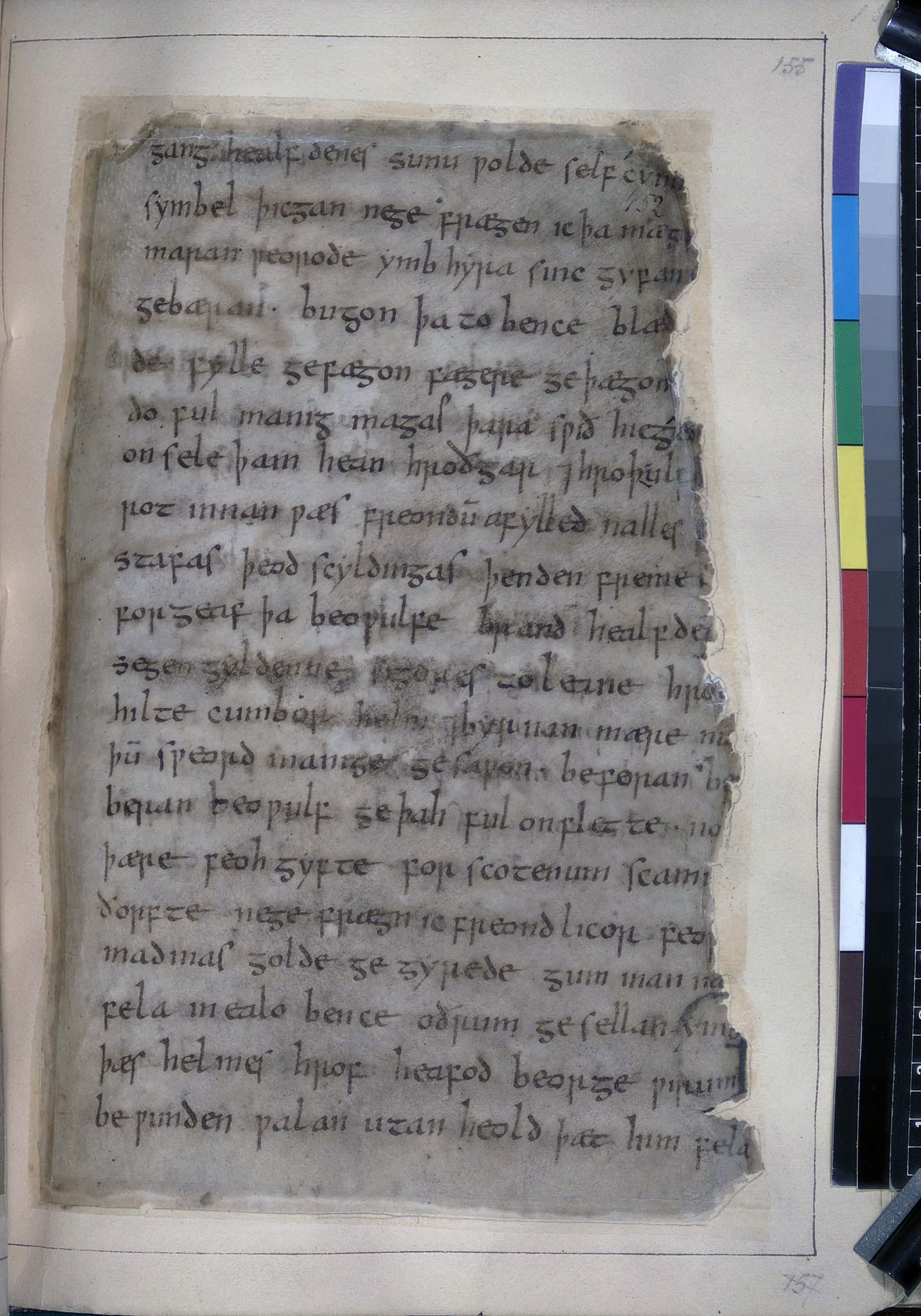
Old English frēond is the directly attested source-language noun behind modern friend. OED analyzes it as an inherited strong masculine agent noun in -nd, ultimately a noun use of the present participle of the Germanic base behind free, and documents West Saxon frēond, Northumbrian and Kentish frīond, Kentish frīand, mutated frīend and frȳnd, endingless plurals, and re-formed frēondas. Bosworth–Toller prints freónd and friónd, explicitly links freónde loving to freón or freógan, and supplies examples for companion, ally, relation, friend of God, friend versus foe, and friends acting as arbitrators. OED independently preserves close companion, non-enemy, ally, and kinsman senses in Old English. Cotton MS Vitellius A XV folio 152r was directly inspected at Beowulf 1018, where the pixels visibly preserve freondum in Heorot innan wæs freondum afylled. The route reuses the reviewed *frijōnd-, *frī-, and proposed *prī- nodes and then stops. The displayed pronunciation is a normalized approximation, not a recorded voice.
Lineage, to the limit of knowledge
5 steps from today back to *prī- (Proto-Indo-European). An asterisk marks a form reconstructed by comparison, never found written.
- Sound
- OED derives the West Germanic stem vowel from *iu, produced by contraction of the base vowel *ī, earlier *ij, with the participial suffix vowel; Old English ēo and īo reflect branch and dialect development.
- Meaning
- An inherited present-participial agent formation functions as the ordinary noun friend, relation, or favored person in Old English.
- Authority
- Oxford English Dictionary editors · American Heritage Dictionary editors
- Confidence
- The cross-Germanic set and participial morphology are published, but *frijōnd- is reconstructed and the exact prehistoric phonetic sequence was never written down.
- Chronology
- Proto-Germanic reconstruction into Old English textual evidence.
- supports Oxford English Dictionary — friend, n. & adj. (Oxford English Dictionary editors, 2013), Etymology Summary and Form historyPublishes the West Germanic vowel history, Old English dialect forms, nd-stem inflection, and inherited participial formation.
- supports An Anglo-Saxon Dictionary Online — freónd (Joseph Bosworth · Thomas Northcote Toller · Christ Sean · Ondřej Tichy, 2014), Grammar and etymology: freónd, friónd; freónde lovingSupplies the attested Old English noun, paradigm, and explicit participial analysis.
- context American Heritage Dictionary — friend (American Heritage Dictionary editors, 2022), Etymology and Word HistoryIndependently connects Old English frēond with the Germanic loving-agent formation.
- Sound
- The agent noun is built with Germanic present-participial nd-morphology on the *frī- or earlier *frij- base. OED traces the later *iu diphthong to contraction with the suffixal vowel.
- Meaning
- A productive loving or favorably disposed participant becomes a lexical noun for friend or relation. The derivation does not make every later friend literally a person performing a continuous act of loving.
- Authority
- Oxford English Dictionary editors · Bosworth · Toller · American Heritage Dictionary editors
- Confidence
- Three independent dictionary treatments identify the participial relation. The exact lexicalization date and every prehistoric inflection remain unrecoverable.
- Chronology
- Germanic derivation before the daughter-language records.
- supports Oxford English Dictionary — friend, n. & adj. (Oxford English Dictionary editors, 2013), Etymology Summary; agent nouns in -ndIdentifies noun use of the present participle and the inherited agent-noun class.
- supports An Anglo-Saxon Dictionary Online — freónd (Joseph Bosworth · Thomas Northcote Toller · Christ Sean · Ondřej Tichy, 2014), Grammar: freónd, freónde loving, participle of freónMakes the Old English participial relation explicit.
- supports An Anglo-Saxon Dictionary Online — freón (Joseph Bosworth · Thomas Northcote Toller · Christ Sean · Ondřej Tichy, 2014), Headword freón: to free, loveSupplies the attested Old English verb used in the historical analysis.
- supports American Heritage Dictionary — friend (American Heritage Dictionary editors, 2022), Word History: originally one who loves; Germanic *frī-Independently explains the agent meaning and prints the Germanic base.
- Sound
- American Heritage compares Germanic *frī- with Indo-European *prī-. The initial Germanic f corresponds to the older labial stop under the comparative analysis; the exact intermediate morphology is not promoted as attested.
- Meaning
- The reconstructed like, love, or friendliness field is compared across Indo-European, but no one original institution of friendship or freedom is recovered.
- Authority
- American Heritage Dictionary editors
- Confidence
- The source publishes the root cross-reference, while the accessible record does not establish one directly attested proto-form, sentence, or social structure.
- Chronology
- Proposed Indo-European base to Germanic reconstruction.
- supports American Heritage Dictionary — friend (American Heritage Dictionary editors, 2022), Etymology: see prī- in the Appendix of Indo-European rootsPublishes the Indo-European comparison with proposed confidence.
- Sound
- No older form is promoted beyond the proposed *prī- comparison.
- Meaning
- The graph stops before the Old English social range is reverse-engineered into one universal prehistoric institution of love, freedom, friendship, kinship, or alliance.
- Authority
- SET-U editorial boundary · American Heritage Dictionary editors
- Confidence
- The deepest displayed form is already reconstructed and proposed; no reviewed earlier node clears the evidence boundary.
- supports American Heritage Dictionary — friend (American Heritage Dictionary editors, 2022), Deepest displayed prī- cross-referenceSupports stopping after the proposed comparison rather than inventing an earlier form.
Relatives
| Form | Language | Relation | Source |
|---|---|---|---|
| friend | English | the reviewed modern continuation through the Middle English spelling field | Oxford English Dictionary — friend, n. & adj. |
| frẹ̄nd | Middle English | the reviewed intermediate headword with extensive spelling and sense variation | Middle English Dictionary — frẹ̄nd, n. |
| freón | Old English | the attested verb to free or love named behind freónd | An Anglo-Saxon Dictionary Online — freón |
| freógan | Old English | the fuller verb form linked by Bosworth–Toller to freón and freónd | An Anglo-Saxon Dictionary Online — freónd |
| freónde | Old English | the loving present participle named in the historical grammatical analysis | An Anglo-Saxon Dictionary Online — freónd |
| frēondas | Old English | an analogically re-formed strong-masculine plural | Oxford English Dictionary — friend, n. & adj. |
| frīend | Old English | an early West Saxon mutated dative singular and plural form | Oxford English Dictionary — friend, n. & adj. |
| frȳnd | Old English | a late West Saxon mutated form and endingless plural | Oxford English Dictionary — friend, n. & adj. |
| frīond | Old English | a chiefly Northumbrian and Kentish dialect form | Oxford English Dictionary — friend, n. & adj. |
| frīand | Old English | a Kentish form showing unrounding of the diphthong’s second element | Oxford English Dictionary — friend, n. & adj. |
| gefrīend | Old English | a collective predicative plural meaning on friendly terms | Oxford English Dictionary — friend, n. & adj. |
| friūnd | Old Frisian | a West Germanic cognate in the inherited friend family | Oxford English Dictionary — friend, n. & adj. |
| friund | Old Saxon | a West Germanic cognate meaning friend or relation | Oxford English Dictionary — friend, n. & adj. |
| friunt | Old High German | a High German cognate continued by Freund | Oxford English Dictionary — friend, n. & adj. |
| frijonds | Gothic | an East Germanic cognate preserving transparent participial morphology | Oxford English Dictionary — friend, n. & adj. |
| frændi | Old Icelandic | a North Germanic cognate whose Scandinavian center is relation or kinsman | Oxford English Dictionary — friend, n. & adj. |
| fiend | English | the antonym with parallel agent-noun morphology but a different hate root | Oxford English Dictionary — friend, n. & adj. |
| wine | Old English | a separate Old English friend or protector word, not a cognate of frēond | Oxford English Dictionary — friend, n. & adj. |
Journey
- Proposed Indo-European comparative horizon · *prī-American Heritage places the shared Germanic friend and free family under a proposed Indo-European root. This is not a written token, recoverable institution, or single archaeological point.
- Proto-Germanic linguistic horizon · *frī-The like, love, or friendly base is reconstructed from daughter-language evidence. No Proto-Germanic speaker, homeland point, or written occurrence is claimed.
- Germanic participial-formation horizon · *frijōnd-The loving-agent formation predates the daughter-language records, but its exact lexicalization moment and full paradigm remain reconstructed.
- Old English textual record · frēond, frīond, frīand, frend, and inflected formsOED and Bosworth–Toller document dialect, mutation, inflection, companion, ally, relation, patron, and friend-versus-foe evidence across Old English sources.
- England, copying place unresolved · Cotton MS Vitellius A XV, folio 152rThe directly inspected Beowulf folio visibly preserves freondum at verse 1018. The manuscript locates textual survival, not the origin of the word or a single birthplace for its senses.
- Knowledge boundary · beyond the proposed *prī- comparisonThe trail ends before love, freedom, friendship, kinship, alliance, or social membership is promoted as one recoverable prehistoric essence.
Disputes
Was frēond historically a loving-agent formation?
Yes at the comparative word-formation level. OED identifies a noun use of the Germanic present participle, Bosworth–Toller calls freónde loving the participle of freón, and American Heritage independently gives one who loves.
resolved · confidence: established · Historical morphology does not dictate one literal interpretation for every written noun token.
- supports Oxford English Dictionary — friend, n. & adj. (Oxford English Dictionary editors, 2013), Etymology Summary; noun use of the present participlePublishes the inherited participial analysis.
- supports An Anglo-Saxon Dictionary Online — freónd (Joseph Bosworth · Thomas Northcote Toller · Christ Sean · Ondřej Tichy, 2014), Grammar: freónd, freónde loving, participle of freónMakes the Old English relation explicit.
- context American Heritage Dictionary — friend (American Heritage Dictionary editors, 2022), Word History: originally one who lovesIndependently states the agent meaning.
Was every Old English frēond token still a productive participle?
Not demonstrably. OED classifies the word as a strong masculine nd-agent noun, and Bosworth–Toller labels the headword a masculine noun even while preserving its participial history.
open · confidence: probable
- supports Oxford English Dictionary — friend, n. & adj. (Oxford English Dictionary editors, 2013), Form history: strong masculine agent noun in -ndPublishes the noun class.
- supports An Anglo-Saxon Dictionary Online — freónd (Joseph Bosworth · Thomas Northcote Toller · Christ Sean · Ondřej Tichy, 2014), Entry label noun masculine; participial etymologySeparates the headword category from its historical formation.
Did frēond literally mean one who loves in every context?
No. The formation motivates the inherited noun, but attested uses include companion, ally, relation, religious epithet, and legal arbitrator.
resolved · confidence: established · The loving-agent reveal is presented as word formation, not an exhaustive token gloss.
- supports An Anglo-Saxon Dictionary Online — freónd (Joseph Bosworth · Thomas Northcote Toller · Christ Sean · Ondřej Tichy, 2014), Examples under A FRIENDDocuments religious, legal, companion, and antonymic contexts.
- context Oxford English Dictionary — friend, n. & adj. (Oxford English Dictionary editors, 2013), Meanings A.1–A.3Separates companion, ally, and relation uses.
Did Old English frēond mean only a close private companion?
No. OED separates close acquaintance, non-enemy or ally, and relation senses already in Old English; Bosworth–Toller adds patronal, religious, and arbitration contexts.
resolved · confidence: established · The dossier refuses to project one modern friendship norm backward.
- supports Oxford English Dictionary — friend, n. & adj. (Oxford English Dictionary editors, 2013), Meanings A.1–A.3, Old English quotationsPublishes the early semantic breadth.
- context An Anglo-Saxon Dictionary Online — freónd (Joseph Bosworth · Thomas Northcote Toller · Christ Sean · Ondřej Tichy, 2014), Located Old English examplesAdds patronal, religious, and arbitration contexts.
Was the relation or kinsman sense absent from Old English?
No. OED cites the Rushworth Gospels and Laws of Cnut under close relation or kinsman. The sense later becomes regionally restricted in English but is attested in Old English.
resolved · confidence: established · Scandinavian semantic specialization does not make the English kin sense imaginary.
- supports Oxford English Dictionary — friend, n. & adj. (Oxford English Dictionary editors, 2013), Meaning A.3; Rushworth Gospels and Laws of CnutDirectly documents the Old English relation sense.
Could frēond mean political ally or non-enemy?
Yes. OED cites the early Old English Orosius translation for Hannibal never becoming a friend of the Romans and separates ally from intimate-companion use.
resolved · confidence: established · Ally remains distinct from etymological ancestry.
- supports Oxford English Dictionary — friend, n. & adj. (Oxford English Dictionary editors, 2013), Meaning A.2b; Orosius iv.viii.99Supplies the early political-alliance witness.
Are frēond and fēond cognates because Old English pairs them?
No. OED calls fiend an antonym with a similar formation, while the reviewed graph traces the nouns to different love and hate bases. Bosworth–Toller’s pair is rhetorical evidence, not genealogy.
resolved · confidence: established · A context link preserves the historical pair without a false ancestry edge.
- supports Oxford English Dictionary — friend, n. & adj. (Oxford English Dictionary editors, 2013), Etymology Summary: fiend shows a similar formationEstablishes morphological parallel without cognacy.
- supports An Anglo-Saxon Dictionary Online — freónd (Joseph Bosworth · Thomas Northcote Toller · Christ Sean · Ondřej Tichy, 2014), Example: Se feónd and se freóndDocuments the attested rhetorical pair.
- context An Anglo-Saxon Dictionary Online — feónd (Joseph Bosworth · Thomas Northcote Toller · Christ Sean · Ondřej Tichy, 2014), Bosworth–Toller feónd etymologyKeeps the enemy noun on its distinct hate base.
Are frēond, frīond, and frīand separate ancestral words?
No separate lexemes are established here. OED treats them as dialectal reflexes: ēo chiefly West Saxon and Mercian, īo chiefly Northumbrian and Kentish, and īa Kentish unrounding.
resolved · confidence: established · Dialect evidence remains visible without duplicating the headword.
- supports Oxford English Dictionary — friend, n. & adj. (Oxford English Dictionary editors, 2013), Form history: Old English ēo, īo, and Kentish īaExplains the dialect forms.
Are frīend and frȳnd separate friend words?
No. OED explains them as inherited i-mutated inflectional forms, with some analogical re-formation possible elsewhere in the paradigm.
resolved · confidence: established · Inflected forms remain evidence rather than fake lexeme dossiers.
- supports Oxford English Dictionary — friend, n. & adj. (Oxford English Dictionary editors, 2013), Form history: inherited i-mutation in nd-stem inflectionExplains frīend and frȳnd as inflectional evidence.
Did Old English frēond have one regular plural?
No. OED records endingless mutated and unmutated plurals, re-formed frēondas or frīondas, and rare vowel-final analogical forms.
resolved · confidence: established · Variation is a feature of the evidence, not noise to erase.
- supports Oxford English Dictionary — friend, n. & adj. (Oxford English Dictionary editors, 2013), Form history: endingless, re-formed, and vowel-final pluralsPublishes the plural variation.
Can the exact pronunciation of frēond be heard or uniquely recovered?
No. The displayed IPA is a normalized scholarly approximation across written dialect evidence, not one recorded Old English voice.
open · confidence: probable
- supports Oxford English Dictionary — friend, n. & adj. (Oxford English Dictionary editors, 2013), Form history: dialect vowels and incipient monophthongizationProvides written phonological evidence but no recorded voice.
Is *frijōnd- an attested Proto-Germanic spelling?
No. It is a normalized reconstruction behind a published cross-Germanic cognate set.
resolved · confidence: established · The reconstruction remains visibly starred.
- supports Oxford English Dictionary — friend, n. & adj. (Oxford English Dictionary editors, 2013), Cross-Germanic cognates and reconstructed stem-vowel historySupplies comparative reconstruction rather than an attested proto-token.
Does frēond securely descend from exactly *prī-?
The deep comparison is published by American Heritage but remains proposed and less secure than the Germanic participial formation.
open · confidence: proposed
- supports American Heritage Dictionary — friend (American Heritage Dictionary editors, 2022), Etymology: see prī-Publishes the deep comparison without direct attestation.
Does folio 152r prove the earliest use of frēond?
No. The directly inspected object proves one inflected form in one manuscript witness. It is not a birth certificate for the lexeme or the poem.
resolved · confidence: established · The witness is strong object evidence with deliberately narrow scope.
- supports Electronic Beowulf, Fifth Edition (Kevin Kiernan, editor and designer · Emil Iacob, software engineer, 2026), Electronic Beowulf line control at verse 1018Makes the edition-to-object alignment repeatable.
- supports Cotton MS Vitellius A XV, folio 152r — Electronic Beowulf facsimile (British Library · Kevin Kiernan, editor, 2026), Folio 152r; visible freondum afylled sequenceProvides the directly inspected manuscript pixels.
Does freondum at Beowulf 1018 identify every person as a modern intimate friend?
No. The local text says Heorot was filled with freondum, but the manuscript alone does not recover each referent’s exact social relationship or a modern intimacy category.
open · confidence: probable
- supports Cotton MS Vitellius A XV, folio 152r — Electronic Beowulf facsimile (British Library · Kevin Kiernan, editor, 2026), Folio 152r; local Heorot contextEstablishes the visible form and neighboring words only.
- context Oxford English Dictionary — friend, n. & adj. (Oxford English Dictionary editors, 2013), Meaning A.1a; Beowulf 1018Supplies the historical dictionary’s companion classification.
Did frēond become polysemous only after Old English?
No. Companion, ally or non-enemy, relation, religious friend, and social-legal helper uses are already represented in the Old English citation record.
resolved · confidence: established · Later English expands the word further, but it does not create all semantic breadth from nothing.
- supports Oxford English Dictionary — friend, n. & adj. (Oxford English Dictionary editors, 2013), Old English records under meanings A.1–A.3Locates multiple semantic branches in Old English.
- context An Anglo-Saxon Dictionary Online — freónd (Joseph Bosworth · Thomas Northcote Toller · Christ Sean · Ondřej Tichy, 2014), Examples: friend of God, friend and foe, arbitrationIndependently demonstrates contextual breadth.
Witnesses
- Old English, source-reported Elene, friend and foe antithesis, Elene 954; Elen. Kmbl. 1904; Exon. 43a
source-reported“Se feónd and se freónd”lexical_corpus_record · An Anglo-Saxon Dictionary Online — freónd
- Old English, source-reported Gospel translation, friend of publicans and sinners, Matthew 11:19; Luke 7:34
source-reported“Mánfulra and synfulra freónd”lexical_corpus_record · An Anglo-Saxon Dictionary Online — freónd
- Old English, source-reported Anglo-Saxon Chronicle, friend of God, Chronicle 654 and 656; Erl. 29:12 and 32:28
source-reported“He wæs Godes freónd”lexical_corpus_record · An Anglo-Saxon Dictionary Online — freónd
- Old English, source-reported Metres of Boethius, lord regards neither friend nor foe, Metres of Boethius 25:16; Fox 25:31
source-reported“Se hláford ne scrífþ freónde ne feónde”lexical_corpus_record · An Anglo-Saxon Dictionary Online — freónd
- Old English law, source-reported Laws of Æthelberht, friends arbitrate, Laws of Æthelberht 65; Thorpe i.18:14
source-reported“Ðǽr mótan freónd séman”lexical_corpus_record · An Anglo-Saxon Dictionary Online — freónd
- Old English, source-reported Rushworth Gospels, relatives rise against one another, Meaning A.3; Rushworth Gospels, Matthew 10:21
source-reported“ariseþ suna wið freondum”lexical_corpus_record · Oxford English Dictionary — friend, n. & adj.
- early Old English, source-reported Orosius translation, Hannibal as no friend of the Romans, Meaning A.2b; Orosius, History iv. viii. 99
source-reported“þæt he næfre ne wurde Romana freond”lexical_corpus_record · Oxford English Dictionary — friend, n. & adj.
- late 10th or early 11th century Beowulf manuscript, Heorot filled with friends, Cotton MS Vitellius A XV, fol. 152r; Electronic Beowulf alignment at verse 1018
directly inspected“Heorot innan wæs freondum afylled”manuscript · British Library · Cotton MS Vitellius A XV, fol. 152r · facsimile · Cotton MS Vitellius A XV, folio 152r — Electronic Beowulf facsimile
Data for this word: every dataset (JSON, CSV, SQLite).